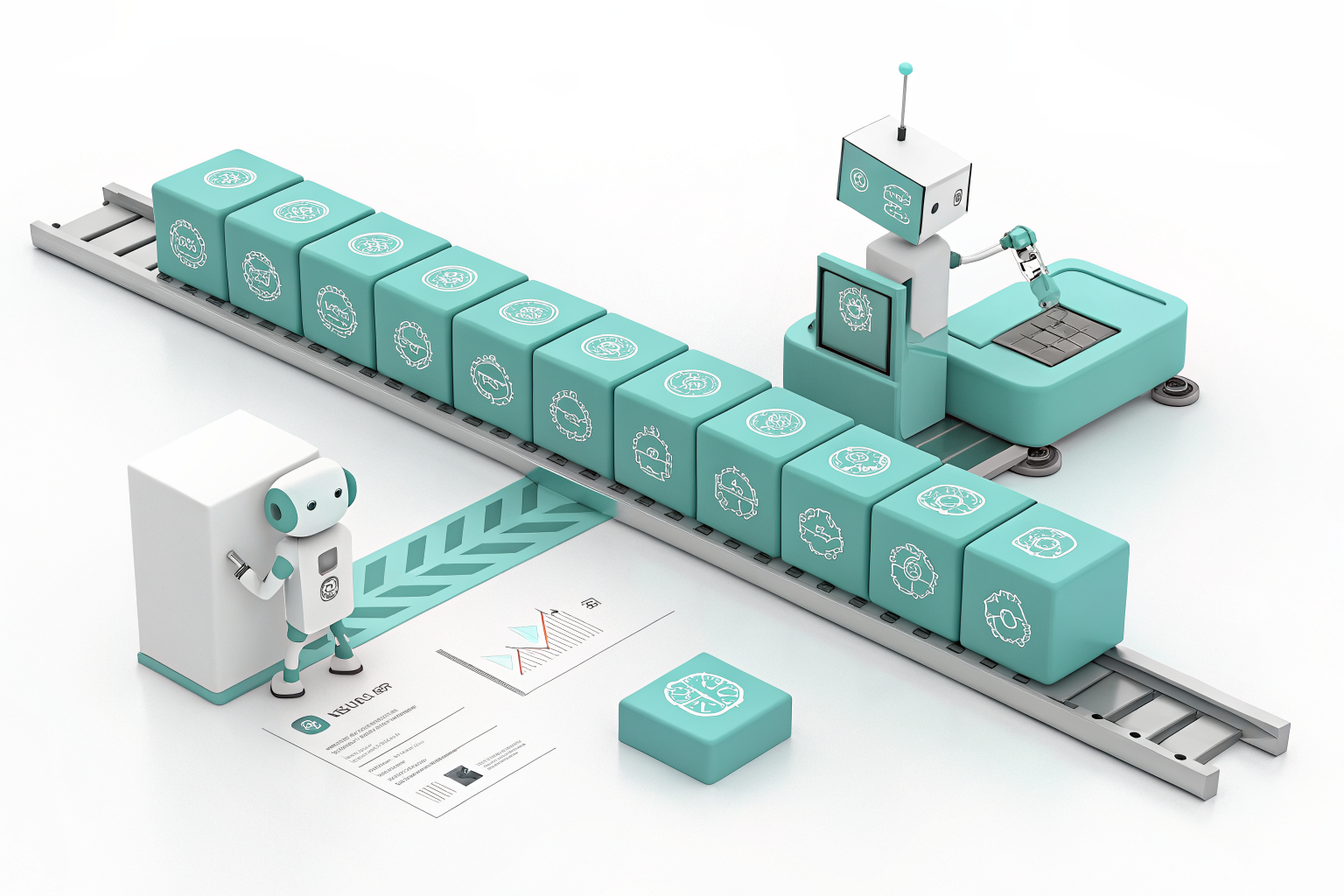

Every keynote this year opens the same way. A founder walks on stage, pauses for effect, and says: “2026 is the year of agents.”
The crowd nods. The slide behind them shows an AI agent autonomously booking flights, filing expense reports, writing Jira tickets nobody asked for. The demo works. The audience claps. And then everyone goes back to their enterprise reality, where changing a pricing rule still requires a six-month program, three steering committees, and a partner who bills by the quarter.
Here’s the problem with “the year of agents”: it assumes the hard part is the agent.
It isn’t.
The hard part is giving your organization the agency to actually do something when the agent figures out what needs doing.
Agents are easy. Agency is architectural.
Let’s be honest about what happened. The frontier model companies shipped impressive demos. Autonomous agents that browse the web, write code, manage calendars. Then enterprise software vendors, the ones who spent two decades locking you into their process definitions, rebranded their workflow engines as “agentic” and called it innovation.
SAP added “Joule.” Salesforce launched “Agentforce.” Oracle… well, Oracle did what Oracle does. Everyone got an agent. Nobody got agency.
Because an agent is only as useful as what it can act on. And in most enterprises, what it can act on is a spaghetti of customized ERP modules, point solutions held together with middleware prayers, and a revenue process that lives partly in Salesforce, partly in SAP, partly in a spreadsheet someone named “Pricing_FINAL_v3_REAL.xlsx.”
An AI agent navigating that isn’t autonomous. It’s lost.
The home you already live in
Think about your actual home for a second. You probably have six apps on your phone: Google Home for the lights, Sonos for the speakers, some app called “Cozy Life” you downloaded at 11pm because the smart plug demanded it, a thermostat app you forgot the password to, and whatever Ring is doing these days.
Each vendor built their own silo. Their own UI. Their own logic. And you, the person who owns the house, have zero agency over how it all works together. You’re a guest in your own home, navigating six vendors’ idea of what your morning routine should look like.
Now imagine every device just exposed a clean API and a common data model. Suddenly, you build one surface. Your home, your rules, your automation. The interface stops being the product. The governed process layer underneath becomes what matters.
Enterprise software is this, but the house costs millions and the smart plug vendor charges you annual maintenance.
Three layers. Only one of them matters.
The headless architecture conversation has been happening in commerce for years. But in 2026, it’s becoming mandatory everywhere. Not because it’s trendy, but because agents need structured data and clean APIs. They don’t care if your UI is beautiful. They need your data model to be unambiguous.
Here’s how it breaks down:
Foundation. Structured data, governed APIs, knowledge graphs. Most enterprise systems lack this because they were designed for humans clicking through screens. Agents don’t need intuitive. They need precise. If your data model requires a human to “just know” that field 47 means something different in EMEA, your agent is going to have a very expensive hallucination.
Process. Flexible business process modeling that works for humans and agents simultaneously. This is the real product. Not the screen. Not the chatbot. The process layer: the logic that says “when this happens, do that, governed by these rules, enforced by this policy.” Define it once. Execute it everywhere. Whether a human triggers it, an agent triggers it, or a dashboard surfaces it.
Interface. This is where it gets interesting. The UI doesn’t disappear. It gets personal. Instead of one interface customized 80/20 for everyone and perfect for no one, you get surfaces tailored to your business, your industry, your role, your speed. It’s not “everything becomes a chatbot.” It’s “your interface is finally yours.”
The process layer is the only one that creates durable value. The other two are expressions of it.
The clarity paradox
Here’s something nobody at the agent keynotes is talking about: when you design systems for agents first, you design for clarity. An API an agent can parse is an API a developer ships faster. A data model an agent can reason over is a data model a human understands with less cognitive load. A process definition an agent can execute is a process definition with fewer errors, fewer edge cases, fewer “ask Stephanie, she knows how it works.”
Agent-ready and human-friendly aren’t opposites. They’re the same thing.
Most enterprise vendors optimize for what we’d call UI theater. Polished screens that mask the underlying mess. The dashboard looks great. The data behind it is duct tape. Fix the mess first, make the logic explicit, govern the process. Then everyone gets exactly the interface they need. Humans get clarity. Agents get structure. The business gets speed.
The real cost of no agency
For twenty years, enterprise software was a top-down constraint. Your vendor decided your process. Your implementation partner forced you into their playbook: their “best practices,” their templates, their timelines. You had zero agency over how your own business operated.
Want to launch a new subscription model? That’s a program. Want to test a new market? File a change request. Want to bundle two products differently for a single customer? Good luck. The system wasn’t designed for that, and the people who customized it left three years ago.
The cost wasn’t just money. It was opportunity. Every revenue motion you couldn’t test was a bet you couldn’t place. Every quarter spent waiting on system changes was a quarter your competitor spent executing.
Most AI thinking stops at step one: cut costs. Automate the data entry. Eliminate the manual process. That’s table stakes. Real thinking is the next several steps: what happens when you free people to do the work that actually generates revenue? A salesperson not entering data is a salesperson closing larger deals. A finance team not reconciling spreadsheets is a finance team forecasting cash flow with precision. Every minute returned to value-add work compounds.
Agency is the unlock
The cost of experimentation has collapsed. But only if your architecture allows it.
Want to test a new revenue motion? Model it. Execute it. Measure it. In weeks, not years. The barrier that used to cost millions (the ERP program, the integration project, the 18-month transformation) has dropped to near zero. But only if execution lives in a layer designed for speed, governed by policy, and decoupled from systems that were never built to move this fast.
This is what the “year of agents” crowd misses. The agent is a reasoning engine. It’s brilliant at figuring out what to do. But doing it, executing a pricing change, launching a motion, unifying revenue logic across acquisitions, that requires an execution layer. Governed. Deterministic. Independent of ERP release cycles.
AI reasons. Something has to execute. ERP records.
That middle layer, the execution layer, is what gives organizations their agency back.
The shift
From “what can the software let us do” to “what does our business need, and how do we build it.”
From vendor-dictated processes to business-defined revenue motions.
From agents coordinating around broken architecture to agents reasoning on top of governed execution.
From the year of agents to the year of agency.
2026 isn’t about who has the most autonomous AI. It’s about who has the architecture that lets them act on what AI discovers. The frontier labs will keep shipping impressive models. The legacy vendors will keep slapping “agentic” on last decade’s workflow engine. And the organizations that actually win will be the ones who built the execution layer that turns reasoning into revenue.
The agents are here. The question is whether your enterprise has the agency to use them.
viax is the governed execution layer that turns business intent into revenue. AI reasons. viax executes. ERP records.