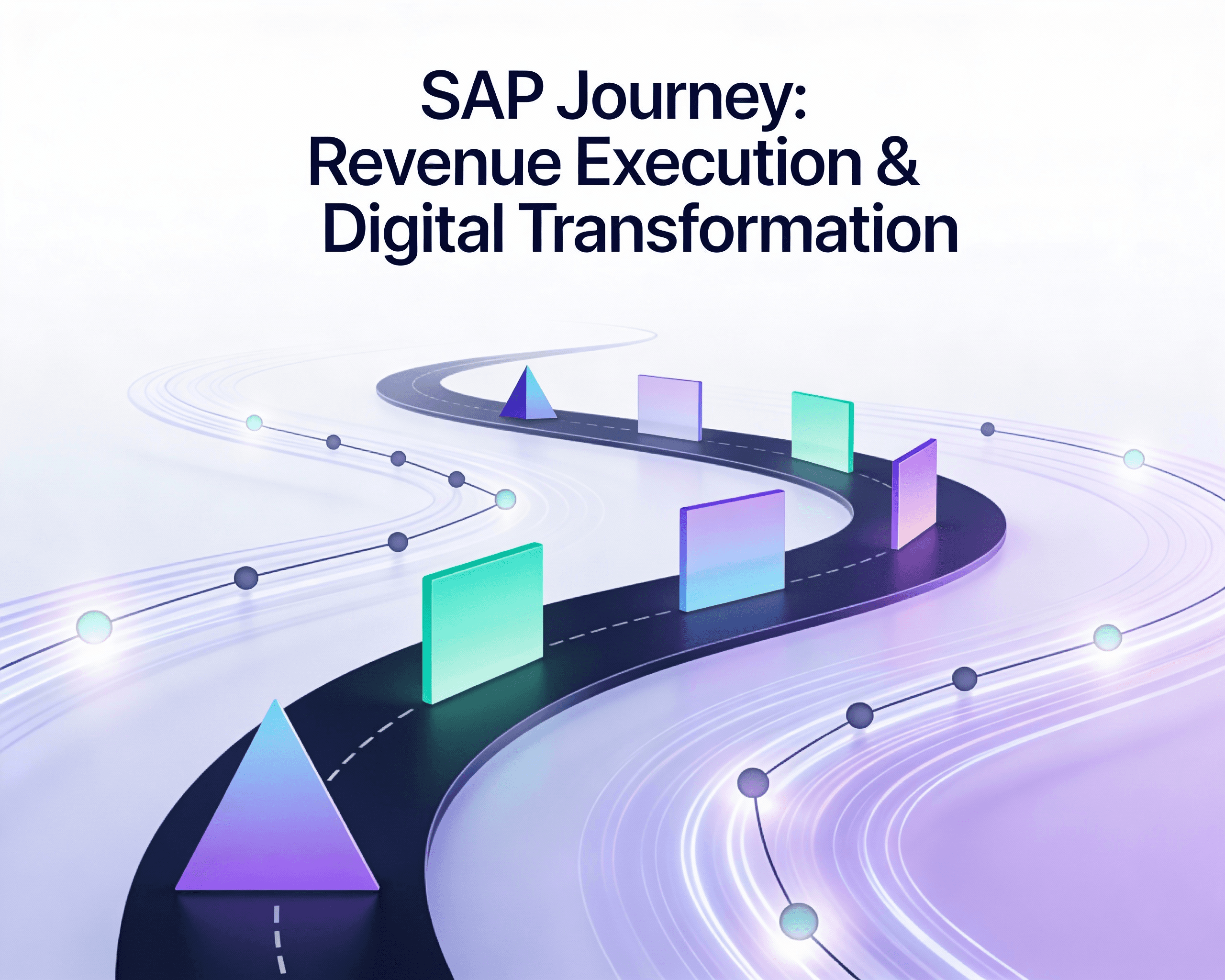
The SAP journey is not a moment—it’s a continuum
For most enterprises, the SAP journey is not a clean before-and-after transition. It’s a multi-year continuum shaped by legacy investments, ongoing operations, acquisitions, divestitures, and changing business priorities.
Some parts of the business are still running on ECC. Others may be piloting S/4HANA. Many organizations are operating hybrid landscapes with parallel systems and overlapping timelines.
The problem is that business expectations don’t pause for transformation programs. Revenue models continue to evolve. Markets shift. Customers demand new buying experiences.
When modernization is tied too tightly to a single ERP milestone, value gets delayed—and risk gets concentrated.
Why revenue execution is where SAP programs break down
SAP systems are excellent systems of record. They were not designed to be systems of continuous change.
Over time, revenue execution logic becomes embedded across:
- ECC customizations
- SAP BRIM and monetization extensions
- SAP BTP applications and workflows
- CPQ and commerce platforms layered around SAP
This logic defines how revenue actually behaves—pricing, eligibility, approvals, policies, and exceptions—but it is scattered and tightly coupled to specific systems.
ERP programs don’t create this problem. They expose it.
As organizations prepare for S/4HANA, they discover:
- Execution logic duplicated in multiple places
- Customizations that are expensive to migrate
- “Temporary” solutions that became permanent
- Clean core goals that conflict with business reality
Revenue execution becomes the largest source of scope, cost, and risk.
Why we created a revenue execution layer
We created viax after seeing the same pattern repeat across SAP-centric enterprises.
No matter the industry or starting point, revenue execution logic kept accumulating in places it didn’t belong:
- Customizations inside ECC
- CPQ and commerce platforms stretched beyond their intent
- Integrations and workflows quietly holding business logic
Each effort made sense in isolation. Together, they created a fragmented execution model that was expensive to change, risky to migrate, and impossible to govern holistically.
We realized the issue wasn’t SAP, S/4HANA, or any single tool. The issue was that revenue execution had no dedicated place to live. It was embedded everywhere, owned nowhere, and forced to move at the pace of the slowest system.
We recognized that without separation, modernization was not possible without severe disruption, risk and cost.
Value across every stage of the SAP journey
Speed, freedom, and de-risking are the core benefits of the viax revenue execution layer—and they create value regardless of where an organization is in its SAP roadmap.
Before S/4HANA Enterprises can modernize revenue execution now:
- Improve pricing, quoting, and customer-facing processes
- Reduce pressure to customize ECC further
- Extract execution logic before it becomes migration scope
Value is delivered immediately, while future complexity is reduced.
During S/4HANA programs The execution layer stabilizes revenue while the backend changes:
- Revenue behavior remains consistent as systems transition
- Migration scope is reduced to core record-keeping processes
- Program risk decreases as fewer customizations move forward
Transformation becomes safer and more predictable.
After S/4HANA The execution layer protects the clean core:
- New revenue models don’t require ERP re-customization
- Execution logic evolves without destabilizing SAP
- Innovation continues without restarting transformation cycles
S/4HANA remains clean, upgradeable, and resilient.
Why this matters to CFOs
For CFOs, SAP transformations are measured in cost, return, and risk.
A revenue execution layer:
- Accelerates time to value without waiting for ERP milestones
- Reduces capitalized customization and migration scope
- Preserves optionality in timing and investment decisions
- Improves ROI on existing SAP investments
Instead of concentrating risk into a single transformation event, value is delivered incrementally and predictably.
Why this matters to CIOs
For CIOs, the challenge is architectural integrity under constant change.
A revenue execution layer:
- Makes clean core achievable, not aspirational
- Separates execution logic from systems of record
- Reduces technical debt before and during migration
- Establishes a clear boundary for future change
Execution becomes governable, observable, and reusable—without turning SAP into a bottleneck.
A better sequencing strategy for SAP transformation
This approach is not about avoiding S/4HANA. It’s about sequencing transformation intelligently.
Execution-first modernization allows:
- Business change to proceed at market speed
- ERP transformation to proceed at operational speed
- Risk to be distributed instead of concentrated
The smartest SAP programs don’t force the business to wait. They decouple revenue execution so transformation can move at the pace the enterprise requires.