
Every revenue change program starts the same way. A business decision — a new motion, a pricing update, a bundling change — lands on the agenda. It is modeled in a deck. It is approved in principle. Then it moves into implementation, and the timeline that was measured in weeks becomes quarters. Not because the change is hard. Because the systems it has to be routed through were not built for it.
The situation architects recognise
The problem is structural. Revenue execution — the logic that governs how a business moves from commercial intent to collected cash — has never had a dedicated home. It lives inside ERP, fragmented across point solutions, and stitched together with integrations built over years. This is not a configuration problem. It is an architectural one.
The result is a pattern most CIOs know well: every revenue change triggers an ERP impact assessment. Every motion requires coordination across teams that were not designed to move together. 61% of SAP ECC customers have yet to complete their move to S/4HANA — more than a decade after release. That stat is not about ERP failure. It is about the weight of execution logic that has accumulated inside systems built to record, not to run.
Why the constraint is architectural, not operational
The instinct, when implementation timelines overrun, is to add resources — more integration engineers, more project management, more governance overhead. But the constraint is not headcount. It is architecture.
When revenue execution lives inside ERP, every change has blast radius. A pricing update touches order management. A new bundling motion affects billing logic. A subscription change intersects with fulfillment. None of these are independent. They share tables, workflows, and validation logic that cannot be moved in isolation. The 3–5× timeline overrun typical of revenue change programs routed through ERP is not a failure of execution discipline. It is a predictable consequence of routing change through a system designed for stability, not speed.
Only 8% of SAP customers complete migrations on schedule. The rest are not failing at project management — they are discovering that the execution logic accumulated inside ERP is harder to move than the ERP itself.
The viax approach — externalise execution, keep ERP stable
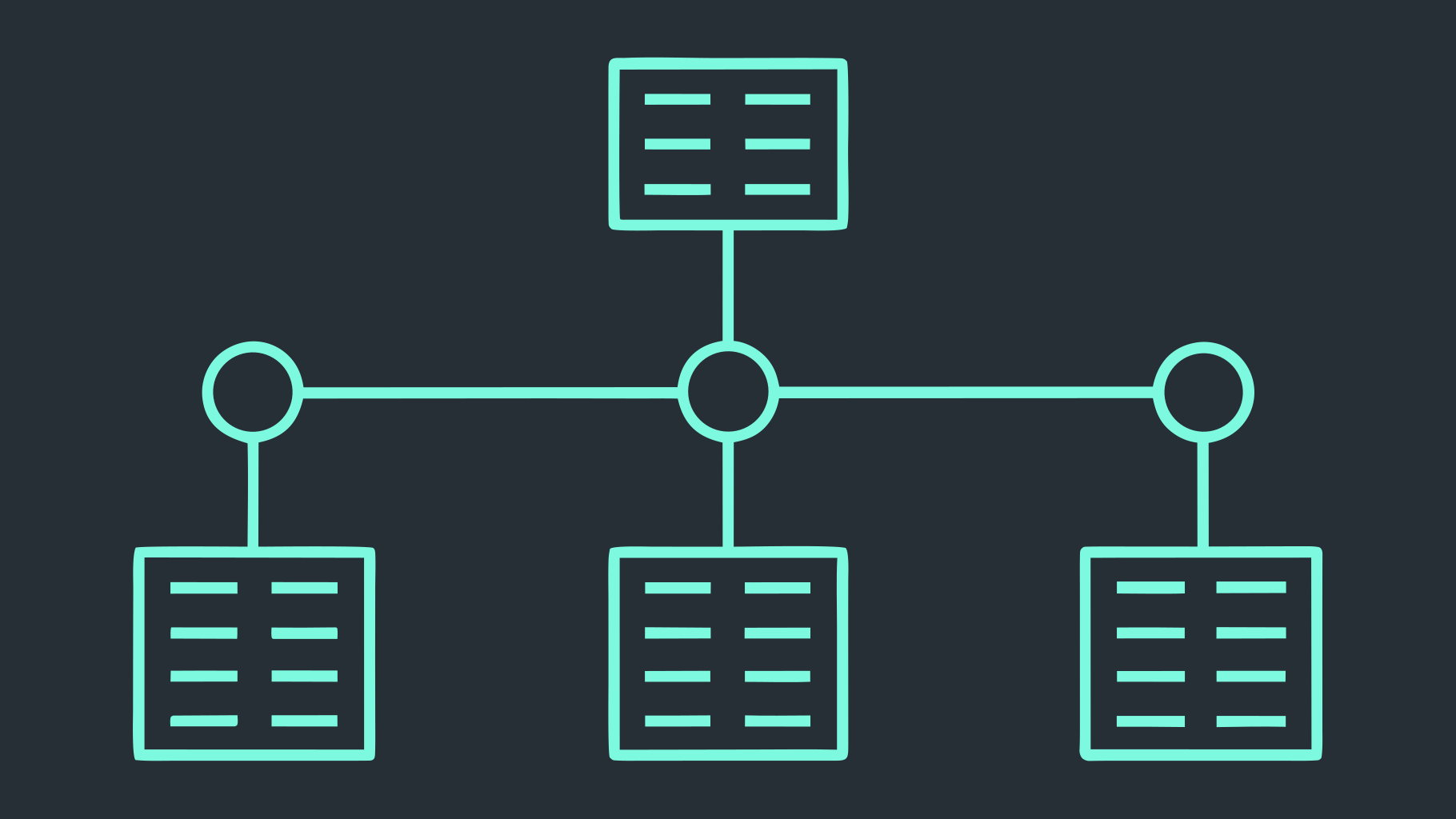
The pattern viax enables is architecturally different. Rather than routing revenue change through ERP, enterprises externalise the execution layer — moving the logic that governs Revenue Motions into a governed, deterministic layer that operates independently of ERP. ERP continues to record. viax executes.
In practice, this means a new Revenue Motion can be modeled and made live without touching ERP configuration. A pricing change does not trigger a change request to the ERP team. A new bundling structure does not require a release cycle. The Revenue Execution layer is separate, governed, and purpose-built — which means it moves at the speed of the business decision, not the speed of the system.
For architects evaluating this approach, the structural benefit is compounding. Clean core becomes achievable. The customisation debt that accumulates with every ERP-routed change stops growing. And the AI readiness that has become a board-level priority has somewhere to land — a deterministic execution layer where AI agents can reason and act without unpredictable customised ERP logic underneath them. That is what AI-ready architecture actually requires: not an AI overlay on a fragmented stack, but a governed substrate purpose-built to execute.
What the implementation pattern looks like in practice
The entry point is typically a single Revenue Motion — a pricing update, a new commercial structure, a subscription motion — that the business needs to run faster than the current architecture allows. viax models it. The proof-of-value runs in weeks. The motion goes live. ERP is untouched.
That pattern repeats. Each motion that moves into the execution layer reduces the load on ERP. The blast radius for the next change is smaller. The team that once spent months on impact assessments starts spending weeks on implementation. For enterprises that have been measuring revenue change in seven-figure program budgets, the economics shift materially — and they do so before any transformation commitment is required.
Proof before commitment. That’s the deal.
This is also why the implementation conversation with viax starts differently than it does with most vendors. There is no transformation roadmap to agree first, no enterprise architecture alignment exercise before value is proven. The motion runs. The timeline is compared. The case for the architectural shift makes itself.
The implication for architecture teams
The question architects are asking is not whether this pattern works. It is where to start. The answer is consistent across the enterprises that have applied it: start with the motion that is most constrained. The one that has been on the roadmap for two or three quarters without landing. The one that keeps being deferred because the ERP impact is too expensive to absorb right now.
That motion is the proof point. Model it outside ERP. Run it deterministically. Measure the difference. The architectural argument does not need a whitepaper. It needs a working motion and a timeline comparison.
When the pattern lands, it lands fast. And the enterprise does not have to commit to a transformation program to find out whether it works. The faster path to revenue execution is not a better implementation of the same architecture. It is a different one.