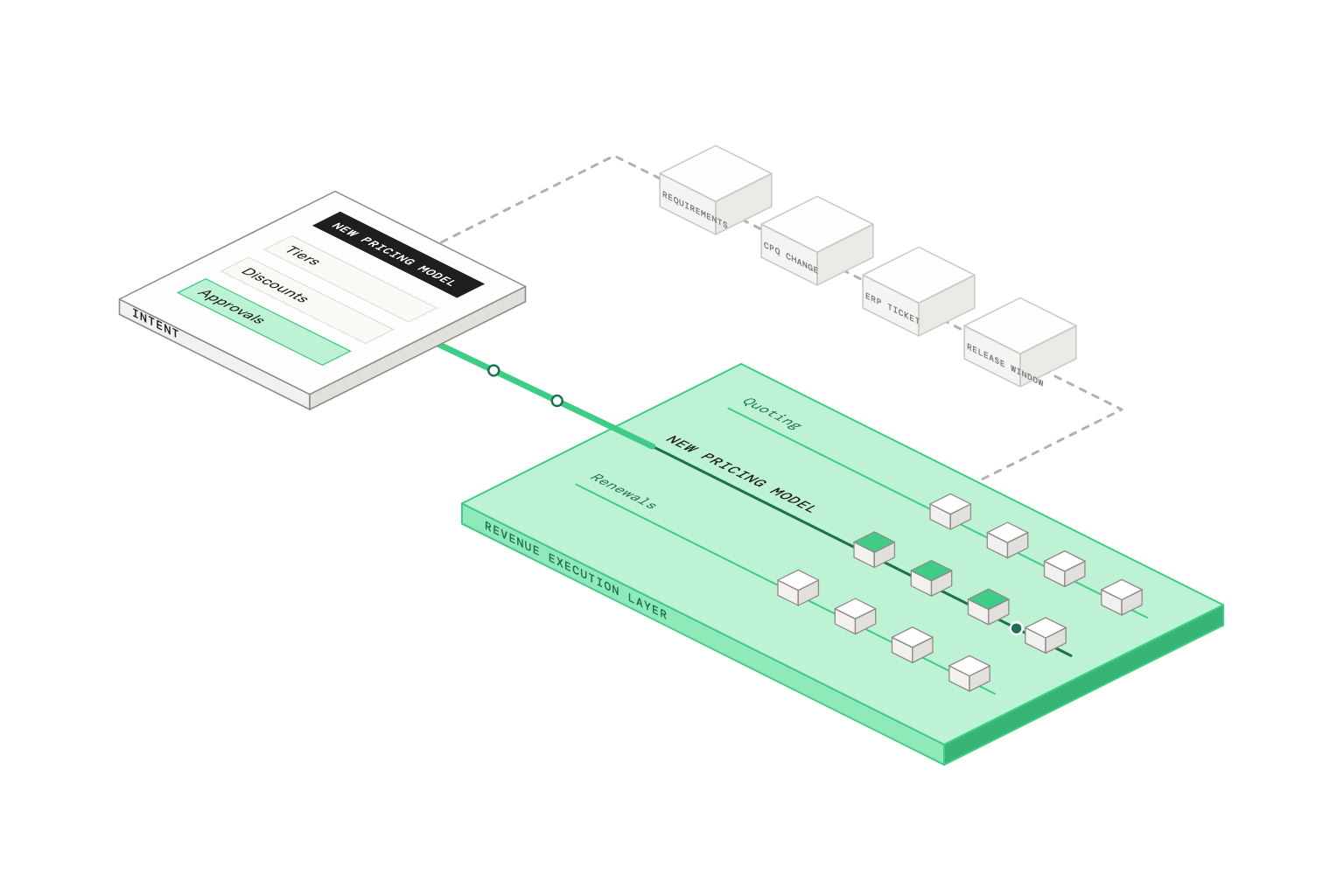
A new pricing model gets approved in the quarterly business review. The revenue team knows exactly what it wants: the tiers, the discounts, who approves what above which threshold. Then the decision goes into the queue. It becomes a requirements document, a CPQ change request, an ERP ticket and a release window. By the time it runs, the quarter it was meant for is over.
Deciding is fast. Running is slow.
Revenue leaders rarely lack decisions. They lack a way to put those decisions into the market at the speed they were made. A new channel, a partner tier, a bundle for an acquired product line, a renewal offer for at-risk accounts: each is clear in the room where it is decided, and each slows down the moment it leaves.
The slowdown is not a failure of effort. Systems teams work hard to deliver what the business asks for. The problem is that the decision has to be translated, and every translation is a handoff, a queue and a chance to lose something. Revenue change programs routed through ERP typically run 3–5× over their timelines. The decision was never the bottleneck.
Why the decision gets lost on the way
Revenue execution has never had a layer of its own. It lives in fragments: pricing logic customised into ERP, quoting rules inside a CPQ platform, contract terms in a separate system, approvals in email and spreadsheets. Each system was built to do something else, and each holds a piece of how the business sells.
So the business adapts to the systems. A pricing structure gets watered down because the CPQ platform can’t express it. An approval chain gets flattened because the ERP release calendar can’t absorb it. Over time, what the business runs drifts away from what it decided. Tools were bought to fit the motion. The motion was never modeled.
This is the Execution Gap: the distance between what a business needs to do and what its systems will allow. This is not a process problem. It is an architectural one.
What intent to execution means
Intent to execution means a business decision runs as decided: modeled the way the business operates, and live when the business chooses. Nothing gets lost in translation, because the decision itself becomes the model that runs.
It rests on three things. Control: the business decides what changes, not the release calendar. Pace: the change goes live when the business is ready, not when the next system window opens. Fidelity: the motion runs the way the business actually operates, with its real tiers, exceptions, participants and approvals intact, rather than the nearest shape a tool could support.
Intent to execution. Modeled the way your business runs, changed at the pace it decides.
It follows from a conviction viax has held from the start. Revenue execution should be as fast to change as the business needs to move.
Your revenue roadmap, outside ERP timelines
Pace starts with separating execution from the system of record. ERP is very good at what it was built for: recording the financial truth of the business. It was never designed to be the place where every pricing, quoting and order change has to be engineered. When execution runs in a governed layer outside ERP, ERP stays stable and clean, and the revenue roadmap stops waiting on the ERP roadmap.
A Fortune 500 medical device manufacturer showed what that looks like in production. In 2021, its distributors needed self-service ordering, real-time pricing and shipment visibility, and the company was told full order management would have to wait for its S/4HANA migration, a timeline running to 2027. Instead, it ran order execution in viax across ECC and S/4HANA at the same time. Manual order entry was eliminated entirely. Half its sales organisations migrated to S/4HANA with zero disruption to distributors, who never saw the migration happening beneath them. Read the full story.
The business outcome arrived years ahead of the ERP timeline. That is pace.
Modeled the way the business runs
Fidelity is the harder promise, and the one most systems quietly give up. When a business says it needs a division to quote custom configurations with regional pricing and approval gates above a set threshold, that sentence is the motion. The traditional answer translates it into a software category, and the specifics disappear into the category’s defaults.
viax models the motion as described. The revenue team describes it in plain language, alongside the policies, pricing workbooks and approval matrices it already has. viax clarifies what it needs to know: thresholds, exceptions, who approves what. The team reviews the motion as a model before anything runs, and then it executes, governed and consistent for any participant and surface. Describe, Clarify, Model, Execute.
Any revenue motion you can describe, viax can model and execute. For the first time, the limit is imagination — not systems. See the motions catalogue.
What changes for the revenue team
Control is what the revenue team feels when pace and fidelity hold together. A pricing change becomes a decision and a model, not a program. A new channel inherits the rules already governing the others. An acquired product line runs on the same motion as the rest of the portfolio, without waiting for an ERP consolidation first.
The relationship with IT changes too. The systems team stops being the bottleneck for revenue decisions and goes back to keeping the record stable, which is the work ERP does best. Revenue and IT stop negotiating over release windows, because they are no longer competing for the same one.
That is intent to execution. The business decides, and the business runs what it decided.