
Most of the discussion about AI agents in the enterprise lands in one of two places. Either agents are about to run everything, or nobody will let them near anything that matters. Revenue usually ends up in the second bucket, and that’s fair. Nobody wants an agent improvising on pricing or invoicing.
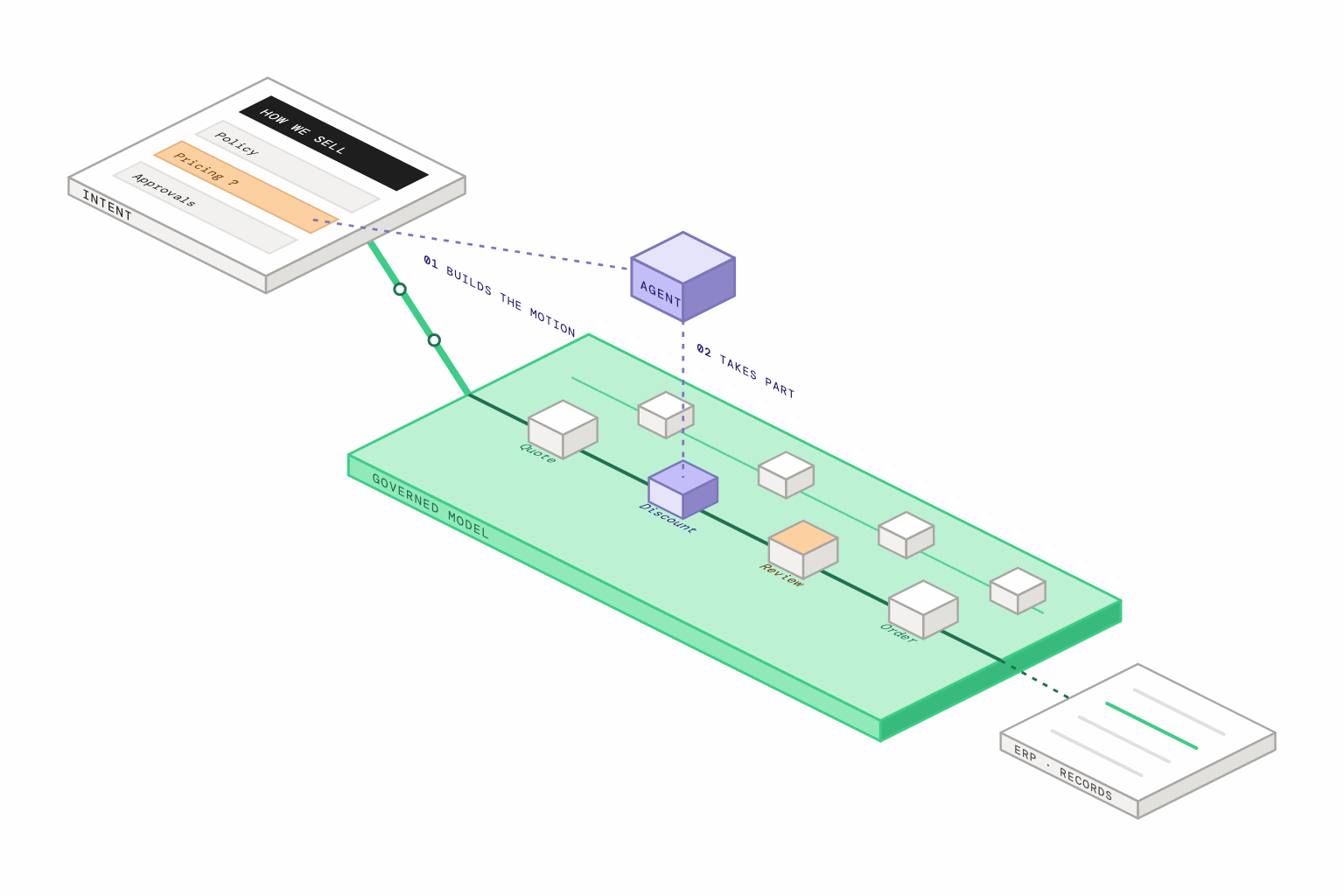
I’ve been in a lot of these conversations lately, and the ones that move forward are never about whether to trust the agent. They’re about what you’re trusting it with, and where. Inside a Revenue Motion, that comes down to two different jobs: helping build the motion, and taking part in it once it runs.
Why revenue keeps landing in the no bucket
Agents can reason about a quote, a discount or a true-up. The trouble starts when they need to act. In most enterprises, revenue execution is spread across CPQ, billing, partner portals, spreadsheets and the ERP, and none of those were designed for an agent to act through. So the agent either acts through a patchwork it can’t see the edges of, or hands its answer back to a person and a spreadsheet.
Neither is a production answer. The first is a risk no CFO will sign off on. The second turns the agent into a suggestion box. It’s the Execution Gap showing up again, this time for AI: the distance between what an agent could do and what the systems around it will let it do safely.
The first job is building the motion
Someone describes how they sell or bill in their own words, with the documents they already have. The agent reads that description alongside the commercial policy, the pricing workbook and the approval matrix. From all of it, it drafts the business execution model: the interactions, how they connect, and how the motion moves from intent to cash.
The part that matters most is what it does with the gaps. Business documents disagree with each other. A policy says one thing and the billing review notes say another. A reseller schedule pays margin on monthly usage and never mentions the true-up. A person reading those documents would guess, or not notice at all. The agent spots the conflict or the silence, asks only about those points, and offers a recommended answer with its reasoning. Nothing is guessed. The business decides.
Once the open questions are settled, viax holds the result as the governed model. That model becomes the reference for everything that follows, including whatever an agent recommends later. A recommendation is checked against rules the business actually agreed to, not against what an agent inferred on the day.
The second job is taking part in it
Once the motion is running, an agent can be a participant on a step, the same way a rep or an approver is. It has a defined step, a defined set of what it can read, the rule model it has to follow and the output it hands back. viax is the deterministic layer it acts through. The agent can reason however it likes. The action itself runs the same way every time.
In our industrial sales example, an agent approves discounts inside policy: 12% on dealer quotes and 15% on direct. Anything above policy goes to a pricing admin, every time. The same motion has an agent recommending replacement parts from a customer’s installed equipment, and that recommendation goes to the rep before the customer ever sees it.
In our usage billing example, an agent drafts each site’s annual true-up from the year’s usage and explains how it reached the number, so billing can check it quickly. It flags sites that should move up a plan. Billing reviews the draft before the customer sees it, because that is the step the model puts first. Nothing reaches a customer or the ERP without the step the model says comes before it.
What makes either job safe to hand over
Both jobs work for the same reason. The agent is never the system of record and never the rulebook. The governed model says what is allowed. The deterministic layer makes sure it happens the same way every time. The ERP records the result.
AI reasons. viax executes. ERP records.
That separation also means enterprises can bring the models they already use. The governance lives in the motion, not in the model, so the choice of model doesn’t have to be the first argument in the room.
It has made these conversations far more practical for the teams we talk to. Nobody is being asked to trust an agent with revenue. They’re deciding which steps an agent takes, under which rules, with which person reviewing. Those are decisions a revenue team already knows how to make.
You can see both jobs in Revenue Motion No. 01 and No. 02 on the Revenue Motions page, and more on how agents work inside viax on AI Execution.