In February the market decided enterprise software was over. A wave of new AI tools landed, software stocks sold off hard, and CNBC asked whether it was “illogical” panic or a SaaS apocalypse. By October the market had changed its mind. The IGV software index had outperformed the S&P 500 by 21% since the end of June, and Salesforce had climbed 40% in August. Both verdicts were wrong, and the reason matters more than the stock chart.
The thesis behind the sell-off was not foolish. Satya Nadella made the case in December 2024: business applications are, at heart, databases with business logic on top, and in an agent era “all the logic will be in the AI tier.” If the logic moves, the application around it loses its reason to exist. The prediction wasn’t wrong. It was early.
Agents stalled where the motion crossed systems
What actually happened in 2026 is that agents hit a wall between the demo and production. Gartner’s 2026 CIO survey found that only 17% of organizations have deployed AI agents, and the firm expects over 40% of agentic AI projects to be canceled by the end of 2027, citing escalating costs, unclear business value and inadequate risk controls. None of those reasons is about what the models can do.
Forrester named the mechanism in its enterprise software predictions for 2027: fewer than 10% of enterprises will use autonomous agents across apps. Enterprises, it wrote, “may trust an agent within one app but will hesitate to let it trigger actions across systems without human oversight.”
The constraint is not reasoning. It is authority.
Reasoning got solved, committing the result did not
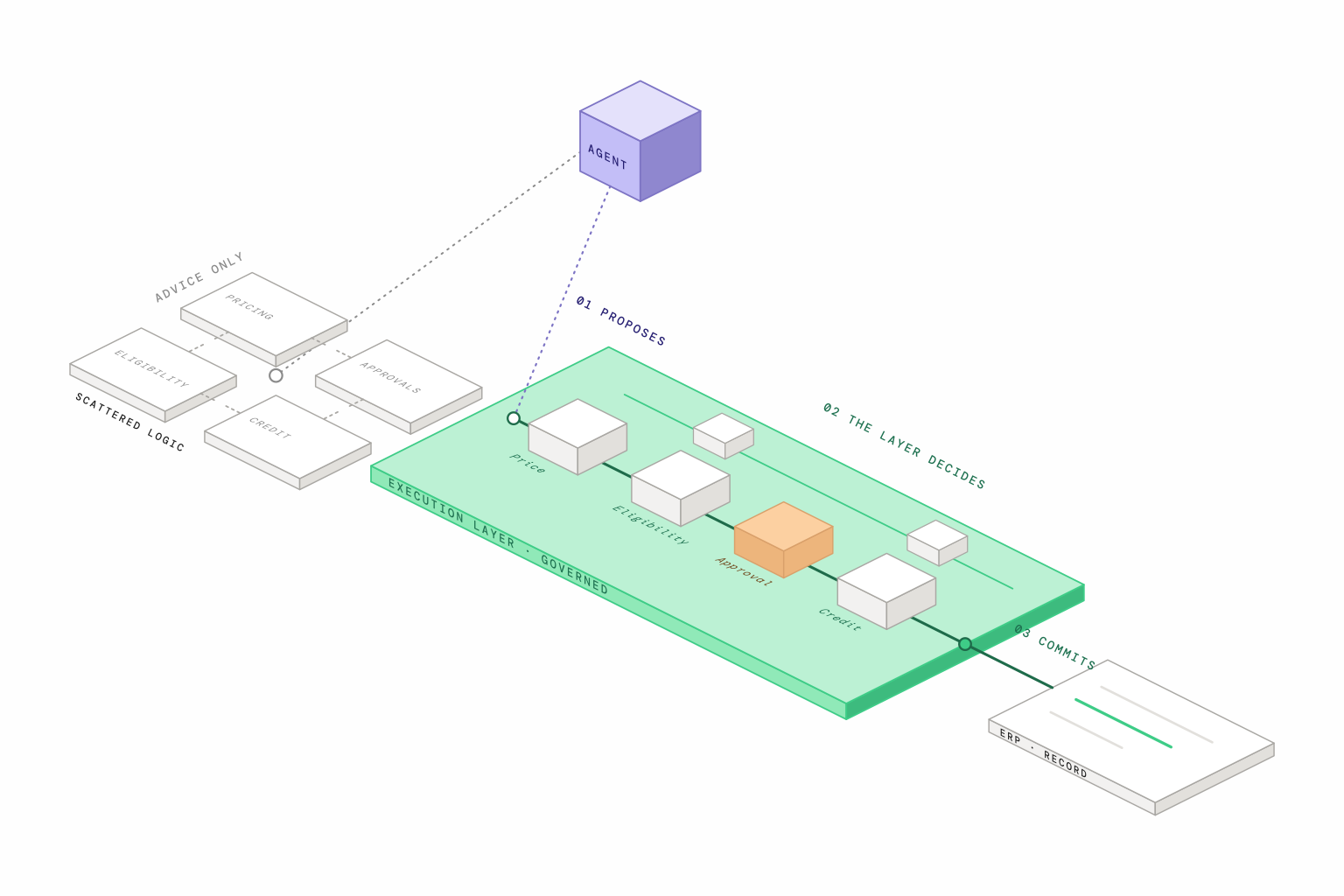
An agent can work out the right discount, the right price and the right approval route. Most of the time. Say that’s good enough. The agent still has to find the systems where the decision gets committed, and hope the policy actually lives there. In most enterprises, pricing sits in one tool, eligibility in another, approvals in a workflow engine and credit in the ERP, with integrations carrying the decision between them. Run the same motion twice through that and an agent may produce two different answers. No CFO signs off on that.
Where agents did displace software in 2026, it was mostly customer service. One system, one action: resolve the ticket, close the ticket. The agent had somewhere to act and a narrow set of things it was allowed to do. Revenue is the opposite. A single quote can touch catalog, pricing, approvals, partner terms, credit and order management before it ever reaches the ERP. Everywhere the motion crossed systems, agents stopped at advice.
The money was deferred, not withdrawn
The spending story points the same way. In late 2025, Forrester predicted that enterprises would defer 25% of planned AI spend to 2027 as the hype met demands for return. Deferred is the operative word. Gartner now forecasts worldwide IT spending to grow 15% in 2027, after AI spending growth of 49.5% in 2026. The budget is there. What it is waiting for is somewhere governed to land.
The apocalypse crowd assumed substitution: an agent in place of an application, a seat you stop buying. That isn’t how revenue works. The logic doesn’t disappear when the screen does. It still has to execute somewhere, the same way every time, with someone accountable for the result.
What an execution layer changes for agents
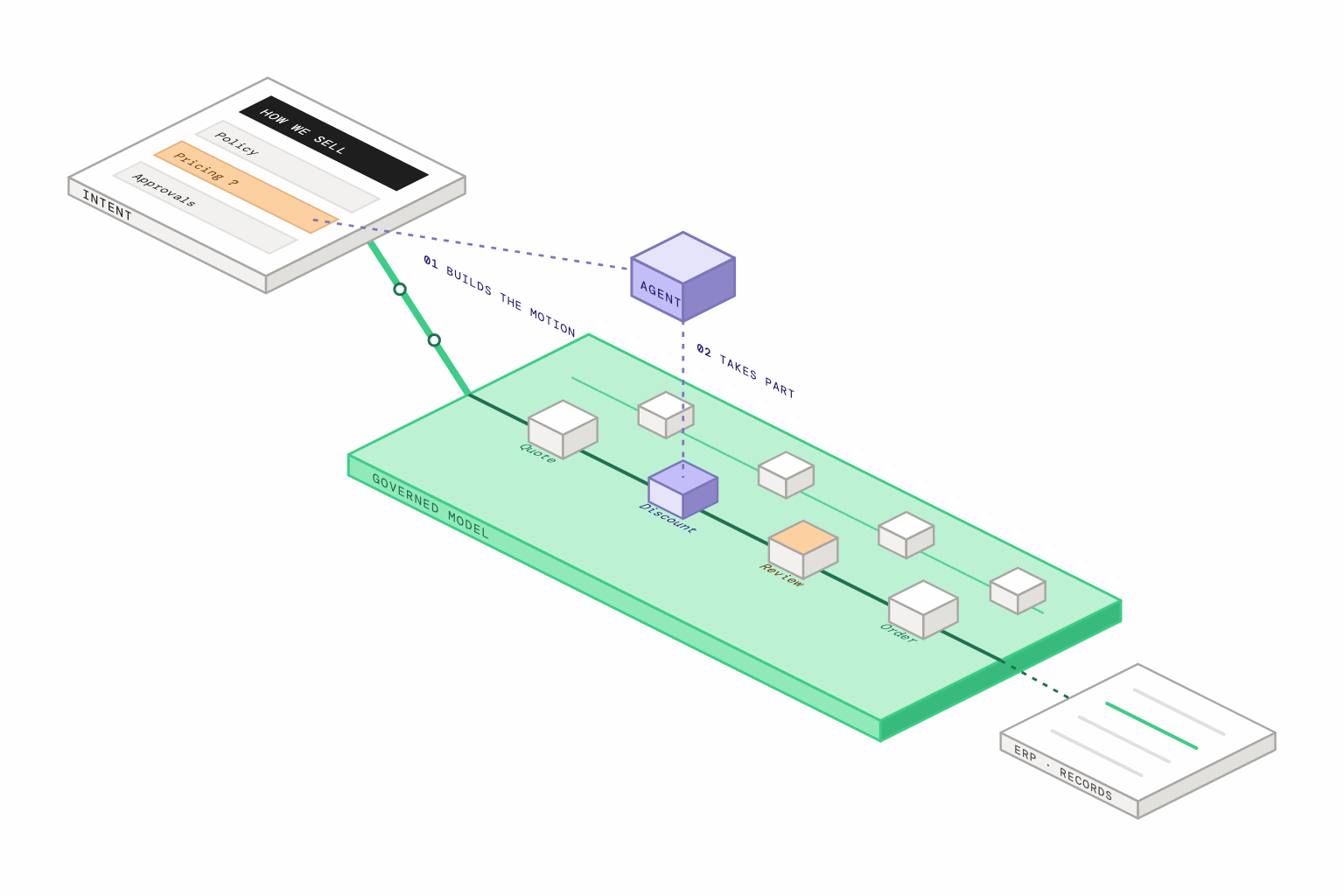
Today the logic that governs revenue is scattered across the systems around it. Point solutions and custom code hold pricing, eligibility, approvals and credit, and the integrations between them have to resync every time one of them ships an update. Move that logic into one layer that every system and every agent calls, and something becomes clear: what enterprises were paying for was never the logic. It was custody of it.
The ERP keeps the record, as it should. The execution layer holds the governed model of how the business sells, prices and approves, and executes it deterministically. Any revenue motion you can describe executes the same way every time, with a full audit trail. Intent in, execution out.
That is what changes the authority problem. An agent acting through an execution layer doesn’t need to be trusted to improvise. It proposes, and the layer decides what is allowed under rules the business already agreed to, then executes it. What the agent triggers is computed, not generated. That is the condition under which an enterprise will let an agent act across systems instead of advising within one. More on how agents work inside viax.
Postponed is not perpetual
The market was right that agents will reshape enterprise software. It was wrong about the timing, because it skipped the step that makes agents safe to put in charge of revenue. Once the execution layer exists, agents move from advisory to accountable, and the shift the market priced in during February starts for real.
The question for every revenue leader is a simple one. When your agent reaches a decision, can it commit it, or does it hand it back to a person and a spreadsheet?